
KitchenAid Whisk Attachment Uses: When to Use the Wire Whip (and When Not To)
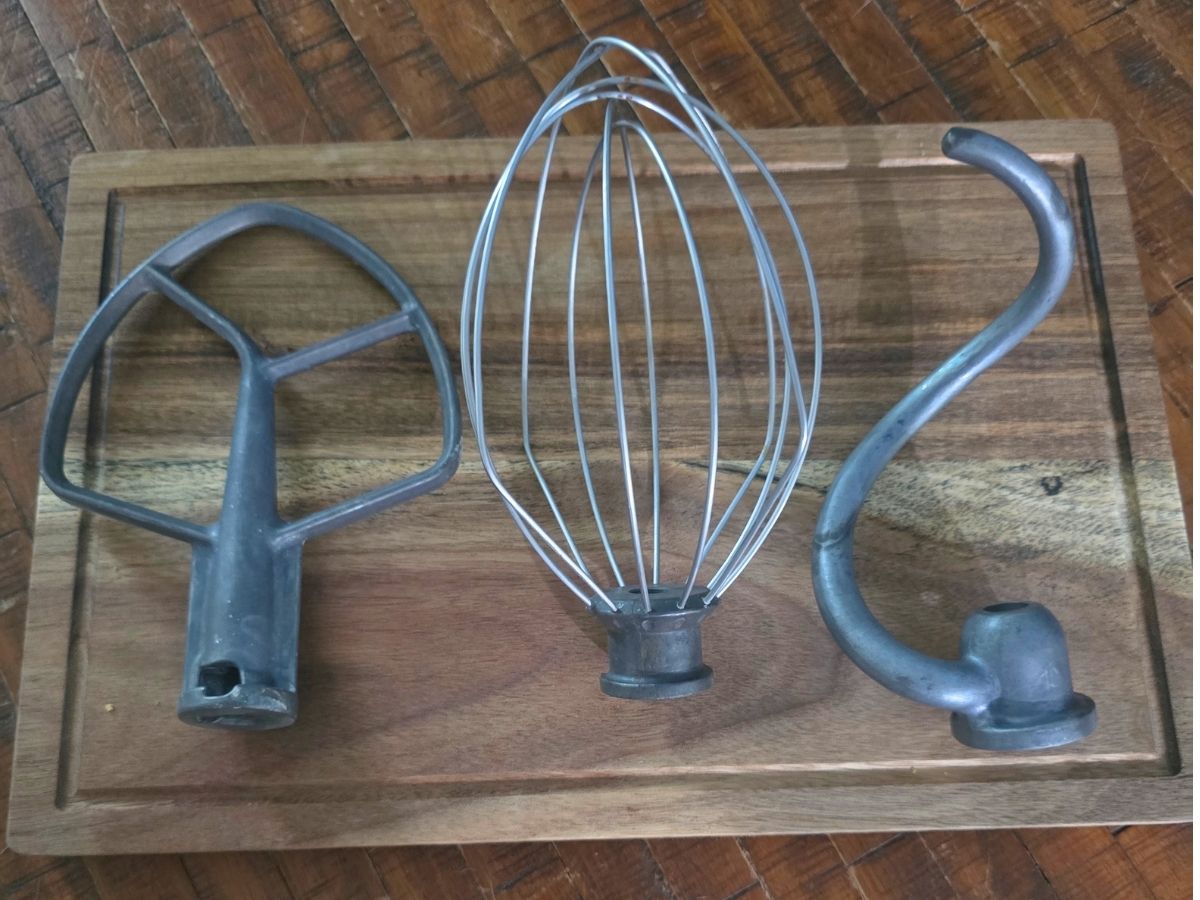
If you’ve ever wondered which of your KitchenAid mixer attachments to use for a recipe, you’re not alone. Understanding the different KitchenAid whisk attachment uses can help you decide when to reach for the wire whisk, flat beater, or dough hook. The wire whisk, flat beater, and dough hook each have different jobs, and choosing the right one can make a noticeable difference in your finished results.
The KitchenAid whisk attachment, also called the wire whip, is designed to incorporate air into ingredients. It’s ideal for whipping cream, beating egg whites, making meringue, and creating light, fluffy textures in desserts.
The flat beater, sometimes called the paddle attachment, is better for everyday mixing tasks such as cake batter, cookie dough, and creaming butter and sugar.
Let’s look at what the wire whisk does best, when to use a different stand mixer attachment, and how to avoid some common mixing problems.
KitchenAid Whisk Attachment Uses: What Can You Make?
The wire whisk is one of the standard KitchenAid attachments included with many stand mixer models. As the mixer runs, the whisk spins on its shaft while traveling around the mixing bowl in a planetary motion.
This mixing process helps incorporate air into wet ingredients, increasing their volume and creating a lighter texture.
If you need to replace your KitchenAid wire whisk attachment, make sure you choose one that’s compatible with your specific stand mixer model.
Unlike the flat beater, which combines ingredients, or the dough hook attachment, which kneads heavier mixtures, the wire whip is designed primarily for aeration.
Here are five ways to put it to work.
1. Making Homemade Whipped Cream
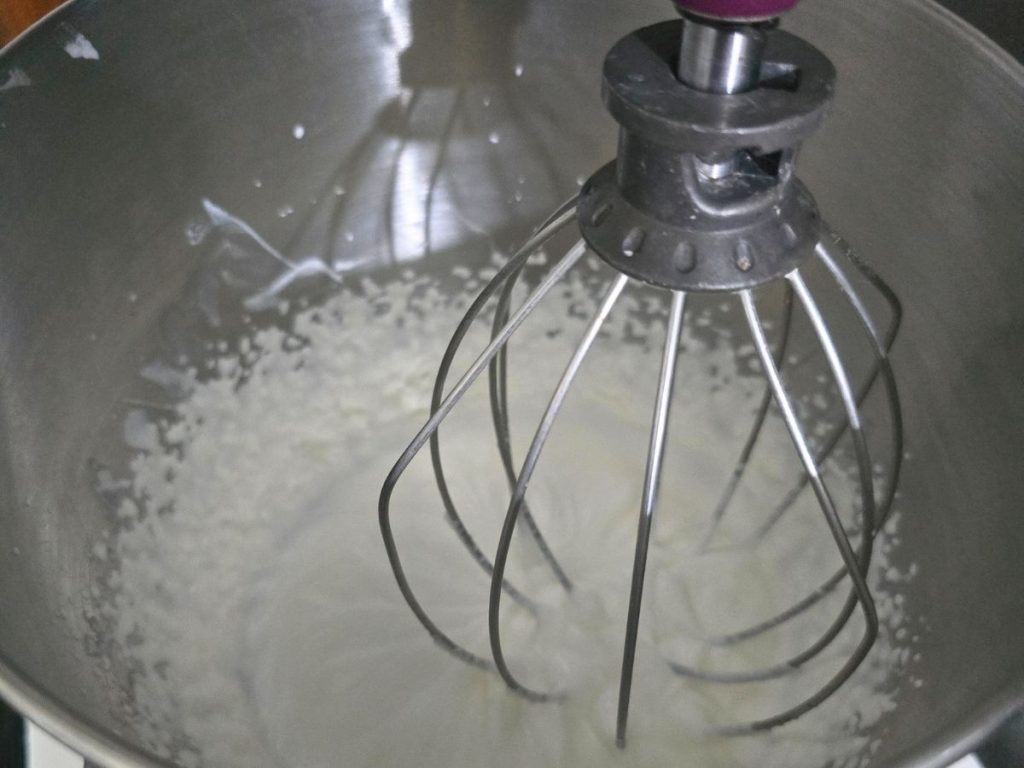
Whipping cream is one of the easiest and most satisfying uses for the wire whisk.
As the whisk incorporates air into cold heavy cream, the mixture thickens and eventually forms soft, medium, or stiff peaks.
Homemade whipped cream is delicious on pies, cakes, strawberry shortcake, hot chocolate, and individual desserts. You can also fold it into chocolate mousse for a lighter texture.
From my kitchen: I use a KitchenAid bowl-lift stand mixer with attachments, and I successfully whipped just ½ cup of heavy cream in its full-size mixing bowl. The whisk had no trouble reaching the cream, so you don’t necessarily need a smaller mixer to make a small batch.
I did have to stop and scrape the sides of the bowl with a spatula as I whipped, but that’s a normal part of using my KitchenAid, whether I’m whipping cream or mixing other ingredients. Here’s a link to some wood handled spatulas that I love! They clean up nice and look professional without paying professional prices.
2. Whipping Egg Whites for Cakes and Desserts
The wire whisk is ideal for beating egg whites into an airy foam. Depending on the recipe, you’ll whip them until they form soft or stiff peaks.
Whipped egg whites provide structure and lift in several types of cakes:
- Angel food cake: Relies on whipped egg whites for its rise and light texture.
- Chiffon cake: Uses whipped egg whites folded into a batter containing oil and egg yolks.
- Sponge cake: Some recipes whip egg whites separately, while others whip whole eggs with sugar.
- Génoise: A sponge cake typically made by whipping whole eggs and sugar until thick and airy.
The whisk can handle both egg-white foams and whole-egg foams, depending on the recipe.
For best results, make sure the mixing bowl and wire whisk are clean and free of grease. Even a little egg yolk can interfere with whipping egg whites properly.
3. Making Meringue and Buttercream Frosting
Meringue starts with egg whites and sugar whipped into a light, airy mixture.
There are three common types:
- French meringue: Sugar is gradually beaten into egg whites, typically without heating the mixture during whipping.
- Swiss meringue: Egg whites and sugar are heated together, then whipped.
- Italian meringue: Hot sugar syrup is poured into whipping egg whites.
Meringue is used for lemon meringue pie, meringue cookies, pavlova, macarons, and certain buttercream frostings.
Swiss meringue buttercream begins with a Swiss meringue base. Once the mixture has cooled, butter is gradually added to create a smooth, silky frosting.
Italian meringue buttercream uses an Italian meringue base before butter is incorporated.
Both frostings are popular for decorating cakes and cupcakes because of their smooth texture and piping qualities.
Some recipes use the whisk for the meringue stage, then switch to the flat beater to incorporate the butter and finish smoothing the frosting.
For traditional American buttercream, the flat beater is usually the better choice.
4. Making Mousse and Other Fluffy Desserts
The wire whisk is useful for desserts that depend on whipped cream, egg whites, or other aerated mixtures.
Examples include:
- Chocolate mousse: Whipped cream or egg whites are folded into a chocolate mixture.
- Strawberry mousse: Often combines strawberry puree with whipped cream.
- Soufflés: Whipped egg whites help a sweet or savory soufflé rise.
- Homemade marshmallows: A gelatin and sugar mixture is whipped until thick and fluffy.
- Whipped chocolate ganache: Certain ganache recipes can be chilled and whipped into a lighter frosting or filling.
Remember that whipping and folding are different techniques.
Use the whisk attachment to incorporate air. When a recipe calls for gently folding whipped cream or egg whites into another mixture, switch to a silicone spatula unless the recipe instructs otherwise.
After all that work incorporating air, you don’t want to stir it right back out.
5. Emulsifying Salad Dressings and Sauces
The wire whisk can also help combine ingredients that don’t naturally stay mixed, such as oil and vinegar.
Some mayonnaise and salad dressing recipes use a whisk to create an emulsion, dispersing tiny droplets of one liquid throughout another.
However, a large stand mixer isn’t always the most convenient tool for a small amount of dressing.
For a simple vinaigrette, a jar with a tight-fitting lid or a shaker bottle works well. Add the ingredients and shake vigorously.
For dressings that require gradually incorporating oil, a hand whisk and small bowl may give you better control.
An immersion blender in a narrow container is another useful option for certain creamy dressings and mayonnaise recipes.
Follow a tested recipe when making mayonnaise, since creating a stable emulsion requires more than simply shaking oil and vinegar together.
KitchenAid Whisk vs. Paddle: Which Attachment Should You Use?
KitchenAid stand mixers are versatile tools, but their beater accessories aren’t interchangeable. Each attachment is designed for a different mixing task.
Here’s a quick guide to choosing the best beater for common recipes.
| What you’re making | Recommended attachment |
|---|---|
| Whipped cream | Wire whisk |
| Egg whites and meringue | Wire whisk |
| Angel food cake egg-white foam | Wire whisk |
| Chiffon cake egg-white foam | Wire whisk |
| Chocolate mousse whipped cream | Wire whisk |
| Cake batter | Flat beater, unless the recipe specifies otherwise |
| Cookie dough | Flat beater |
| Banana bread | Flat beater |
| Creaming butter and sugar | Flat beater |
| American buttercream frosting | Flat beater |
| Swiss or Italian meringue buttercream | Whisk for meringue; sometimes paddle to finish |
| Bread dough | Dough hook |
| Pizza dough | Dough hook |
The easiest way to remember the difference is this:
Use the wire whisk to incorporate air, the flat beater to mix ingredients, and the dough hook to knead yeast dough.
What About Banana Bread?
Despite its name, banana bread is a quick bread, not a yeast bread. That means the dough hook isn’t the right attachment.
Use the flat beater to combine the ingredients, just as you would for many cake batters.
Once the dry ingredients have been added, mix only until they’re incorporated. Overmixing can develop too much gluten, making your banana bread dense or tough.
This same principle applies to many other quick breads and muffins. You want to combine the batter, not knead it.
Do You Need to Scrape the Sides of the Bowl?
Yes! Even though KitchenAid stand mixers use planetary mixing action, ingredients can still collect on the sides of the bowl.
Whether you’re whipping cream, mixing cake batter, or making frosting, you may need to stop the mixer occasionally and scrape the sides and bottom of the bowl with a silicone spatula.
The wire whisk is designed to incorporate air, not scrape the bowl clean. The standard flat beater doesn’t scrape the sides, either.
You may also notice ingredients collecting along the side of the bowl just above the attachment’s reach. Stopping to scrape them back into the mixture helps everything combine more evenly.
KitchenAid also makes a flex-edge beater with a flexible edge that helps scrape ingredients from the bowl during mixing. It’s useful for certain batters and frostings, but it isn’t a replacement for the wire whisk when whipping cream or egg whites.
Always turn the mixer off before scraping the bowl.
When Should You NOT Use the KitchenAid Wire Whisk?
Although the wire whisk is versatile, it isn’t designed for heavier mixtures.
Avoid using it for:
- Cookie dough: Thick dough can become trapped between the wires and strain the attachment.
- Bread dough: Use the dough hook for kneading yeast dough.
- Pizza dough: Like bread dough, pizza dough needs the dough hook.
- Thick cake batter: The flat beater is generally better suited to combining cake ingredients.
- Creaming butter and sugar: The flat beater is designed for this job.
If you’re making chocolate chip cookies, the whisk might look capable of handling the job, but those little wires have enough to do without wrestling a bowl full of cookie dough.
What Speed Should You Use with the KitchenAid Whisk?
KitchenAid generally recommends speeds 4 through 10 for the wire whip, depending on what you’re making.
Medium speeds can help begin incorporating air, while higher speeds are commonly used for whipping cream and egg whites.
Start at a lower speed when necessary to prevent splashing, then gradually increase to the appropriate whipping speed.
Stop the mixer as needed to scrape ingredients from the sides of the bowl.
Watch your mixture closely. Heavy cream can progress from soft peaks to stiff peaks fairly quickly. Continue whipping too long, and it can become grainy before eventually turning into butter.
That’s a perfectly good way to make butter, just not when you were planning on whipped cream.
Always follow your recipe and the recommendations for your particular stand mixer model.
Why Isn’t My KitchenAid Whisk Reaching the Ingredients?
If your wire whisk isn’t reaching ingredients at the bottom of the mixing bowl, there are two possibilities worth checking.
First, the quantity may be too small for your particular bowl and whisk combination. Different KitchenAid stand mixer models have different bowl capacities and attachment designs.
But don’t assume a large bowl automatically means small batches won’t work. I successfully whipped ½ cup of heavy cream in my large bowl-lift mixer.
Second, your mixer may need a beater-to-bowl clearance adjustment.
How to Check KitchenAid Beater-to-Bowl Clearance
KitchenAid recommends checking the clearance using the flat beater and a dime in a stainless steel mixing bowl.
With the flat beater attached, place a dime in the bowl and run the mixer at the recommended low speed for the test.
When the clearance is correct, the beater should move the dime approximately ¼ inch with each pass.
If the dime doesn’t move, the beater may be too high. If the dime moves continuously around the bowl, the beater may be too low.
KitchenAid provides adjustment instructions for both tilt-head mixers and bowl-lift models.
For a bowl-lift mixer, the adjustment screw is accessible with the bowl lowered. Its location can vary between specific models.
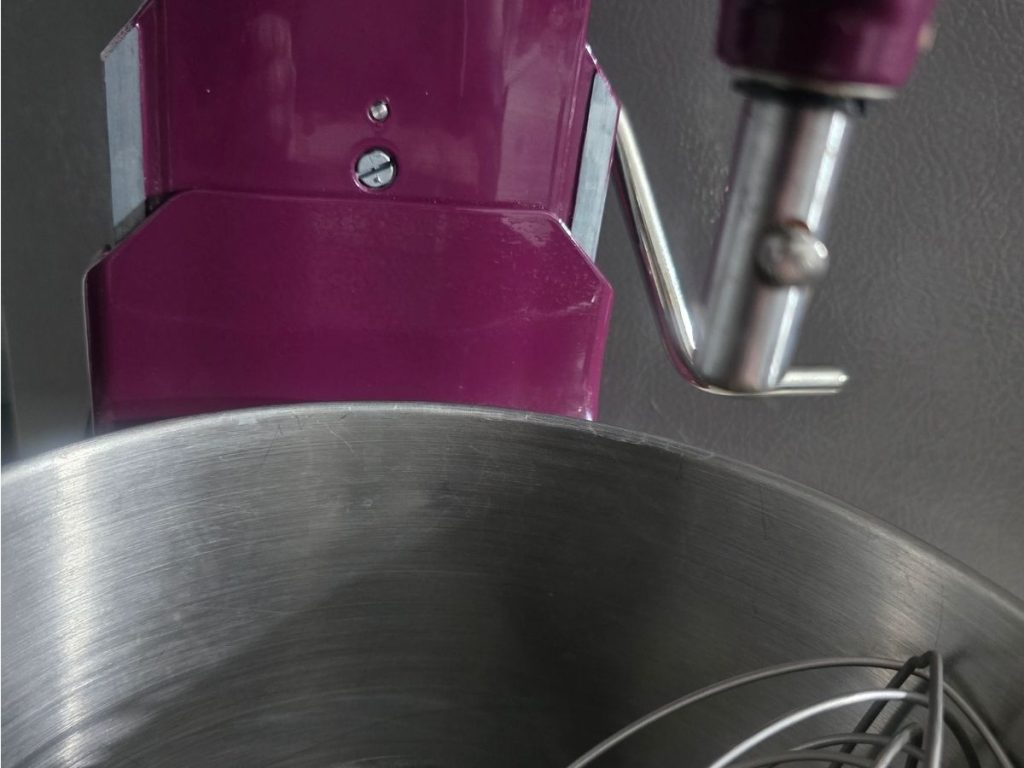
Always unplug the mixer before making adjustments. Make small changes, then repeat the clearance test with the flat beater.
Neither the wire whisk nor the flat beater should strike the bottom or sides of the bowl.
For complete instructions, see KitchenAid’s official guide: https://www.kitchenaid.com/countertop-appliances/pinch-of-help/how-to-adjust-stand-mixer
Is the KitchenAid Whisk Attachment Dishwasher Safe?
That depends on which whisk you own.
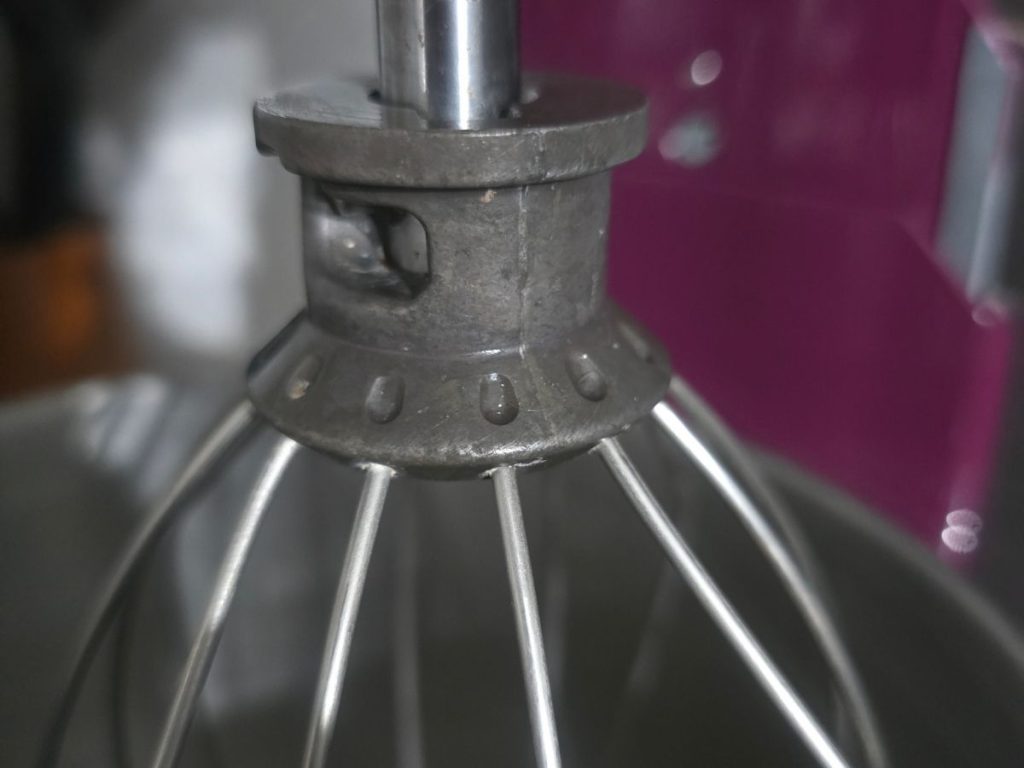
Many KitchenAid wire whips have stainless steel wires attached to an aluminum hub. The hub is the solid piece at the top where the wires connect.
These whisks should be washed by hand and dried promptly. Dishwasher detergent can cause the aluminum to oxidize, leaving gray or black residue.
KitchenAid also offers all-stainless-steel whisks that are dishwasher-safe.
Don’t rely on color alone to identify the materials. Check your whisk’s model number or manufacturer’s care instructions before putting it in the dishwasher.
Why Is My KitchenAid Whisk Turning Gray or Black?
If your whisk develops dark residue around the hub, the aluminum may have oxidized after exposure to dishwasher detergent.
KitchenAid provides cleaning instructions for affected aluminum attachments. If residue remains, follow the manufacturer’s guidance before using the whisk with food.
To help prevent the problem, hand-wash aluminum-hub whisks and dry them immediately.
Frequently Asked Questions
Can I Use the KitchenAid Whisk Attachment for Cake Batter?
The flat beater is usually the better choice for cake batter. The wire whisk is intended primarily for whipping and aerating lighter mixtures, such as the egg-white foam used in angel food or chiffon cakes.
Can I Use the Wire Whisk to Make Buttercream Frosting?
Yes, for certain types. Swiss meringue buttercream and Italian meringue buttercream use the whisk to whip the meringue base. Some recipes switch to the paddle attachment for the finishing stage.
For traditional American buttercream, the flat beater is generally the better choice.
Can I Use the Whisk Attachment for Cookie Dough?
No. The flat beater is the better choice for cookie dough, especially when the mixture becomes thick.
Can I Whip Just ½ Cup of Heavy Cream in a KitchenAid Stand Mixer?
Yes, it’s possible. I successfully whipped ½ cup in my large KitchenAid Professional HD bowl-lift mixer.
Results may vary depending on your mixing bowl, whisk design, and mixer adjustment.
Are All KitchenAid Whisk Attachments Interchangeable?
No. KitchenAid makes different whisks for different stand mixer models and bowl sizes. Check compatibility before purchasing replacement parts or additional mixer accessories.
The Bottom Line
Your KitchenAid wire whisk is the attachment to reach for when a recipe needs air incorporated into the mixture.
It’s ideal for whipped cream, egg whites, meringue, and airy desserts like chocolate mousse. For cake batter, cookie dough, banana bread, and most everyday mixing, the flat beater is usually the better choice.
And if you’re cooking or baking for just one or two people, don’t assume your large stand mixer can’t handle a small batch. Mine whipped ½ cup of cream just fine.
Sometimes it’s simply a matter of using the right attachment for the job.
